

CETIS

Comprehensive Environmental Toxicity Information System

Analyze, maintain, and organize complex toxicity data in one application.

In use at 100+ labs & agencies
U.S. EPAU.S. Geological SurveyEnvironment CanadaWA Dept. of Ecology
What is CETIS

No other specialized toxicity software puts this much analysis, database, and reporting in one application.

Developed by Tidepool Scientific and built on Microsoft Access, CETIS analyzes, maintains, and organizes complex, heterogeneous toxicity data from freshwater, estuarine, marine, and terrestrial tests, across effluents, ambient water, reference toxicants, and sediment.

Much of the analysis can be automated: build decision-tree logic to match your regulatory authority (the U.S. EPA or Environment Canada), so NOEL/LOEL calculations flow into automated point estimates. The result is fast and consistent.

Across four testing domains

Surface & receiving waters, effluent & lab samples, and solids & air, explored in detail just below.

At a glance
Platform Microsoft Access (Windows)
Statistical methods 80+ tests & models
Standards U.S. EPA · Env. Canada · OECD
Validated against R · EPA Probit · SAS
Deployment Multi-user, networked
Maker Tidepool Scientific, since 1992
See editions & pricing →
Environmental media & testing domains

Built for the full range of toxicity testing.

Surface and receiving waters, effluent and lab samples, solids and air: CETIS handles heterogeneous toxicity data across every medium your program tests.

Surface & receiving waters

Surface & receiving waters

Freshwater · Estuarine · Marine · Ambient Water
Effluent & lab

Effluent & lab

Effluents · Reference Toxicants
Solids & air

Solids & air

Terrestrial · Sediment · Soils · Aerosols

CETIS is method-driven and adapts to other media as your program requires.

What CETIS does

Test setup through final report, without leaving CETIS.

It all lives in one database.

“CETIS is a complete toxicity testing database. It sets up the tests, creates the paper work, analyzes the data, prepares the reports, creates control charts, and identifies whether the test meets acceptability criteria or not. I can't imagine anyone doing toxicity testing without CETIS.”
Stan Asato — Supervisor, EMD Toxicity Testing Unit, City of Los Angeles
01 Analyze

The widest statistical method set in one application.

More than 40 hypothesis tests and 40 regression models: the methods you are required to run, integrated in one place. Decision-tree logic selects the method and verifies every assumption, and you can override any decision.

Automation
Decision-tree logic

Automates method selection and assumption checking per jurisdiction. Override any decision at any step.

Multi-jurisdictional
Matches your regulatory authority

CETIS changes its decision rules per jurisdiction, and it's the only software that fully supports the 2005 Environment Canada Guidance Document on Statistical Methods for Environmental Toxicity Tests.

Standards
EPA · EC · OECD

Implements statistical methods described by the U.S. EPA, Environment Canada (2005), and OECD — including WET review and test acceptability criteria.

Validation
Verified to 6 sig figs

Every procedure validated against R or U.S. EPA published programs. Results judged identical to the 6th significant figure or better against EPA Probit, SAS, and S-Plus.

See it in CETIS
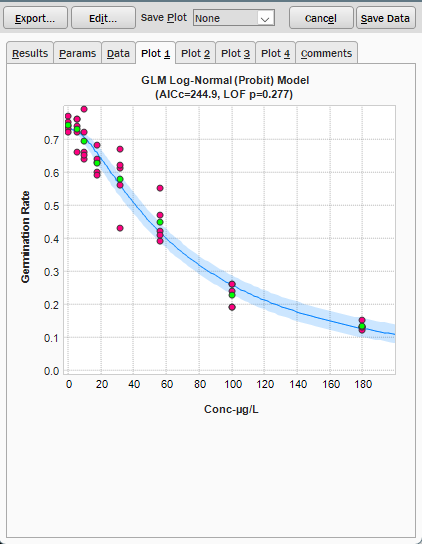
Fit a dose–response curve and CETIS charts it for you: probit plus 40+ regression models, with a 95% confidence band.
CETIS · Linear Regression (GLM) 01 / 05 · ENLARGE ⤢

Fit a dose–response curve and CETIS charts it for you: probit plus 40+ regression models, with a 95% confidence band.

CETIS · Linear Regression (GLM)
Fit a dose–response curve and CETIS charts it for you: probit plus 40+ regression models, with a 95% confidence band.
Method library
Every statistical method CETIS covers — filter by agency or search by name.
02 Maintain

A secure, structured database instead of scattered files.

A split front-end / back-end design on the Microsoft Access file-server platform, with advanced filtering and querying, QC plotting, and data-integrity tracking.

Quality control
QC plots

Levey-Jennings (Shewhart), Cumulative Mean, and Cusum plots, intra- or inter-laboratory, for any point estimate, NOEL, LOEL, PMSD, or control response.

Multi-user
Networking & security

Licensed front-end copies on each workstation share one server-based database, with Microsoft Access user-level security managing access to the application and the data.

Instruments
Serial-port instrument capture

Interface probes, balances, and other instruments directly to the data-entry screens to eliminate transcription errors and speed measurement recording.

Interchange
Import & export

Move records between CETIS databases, including exports to a central authority that maintains a master copy of a database.

See it in CETIS
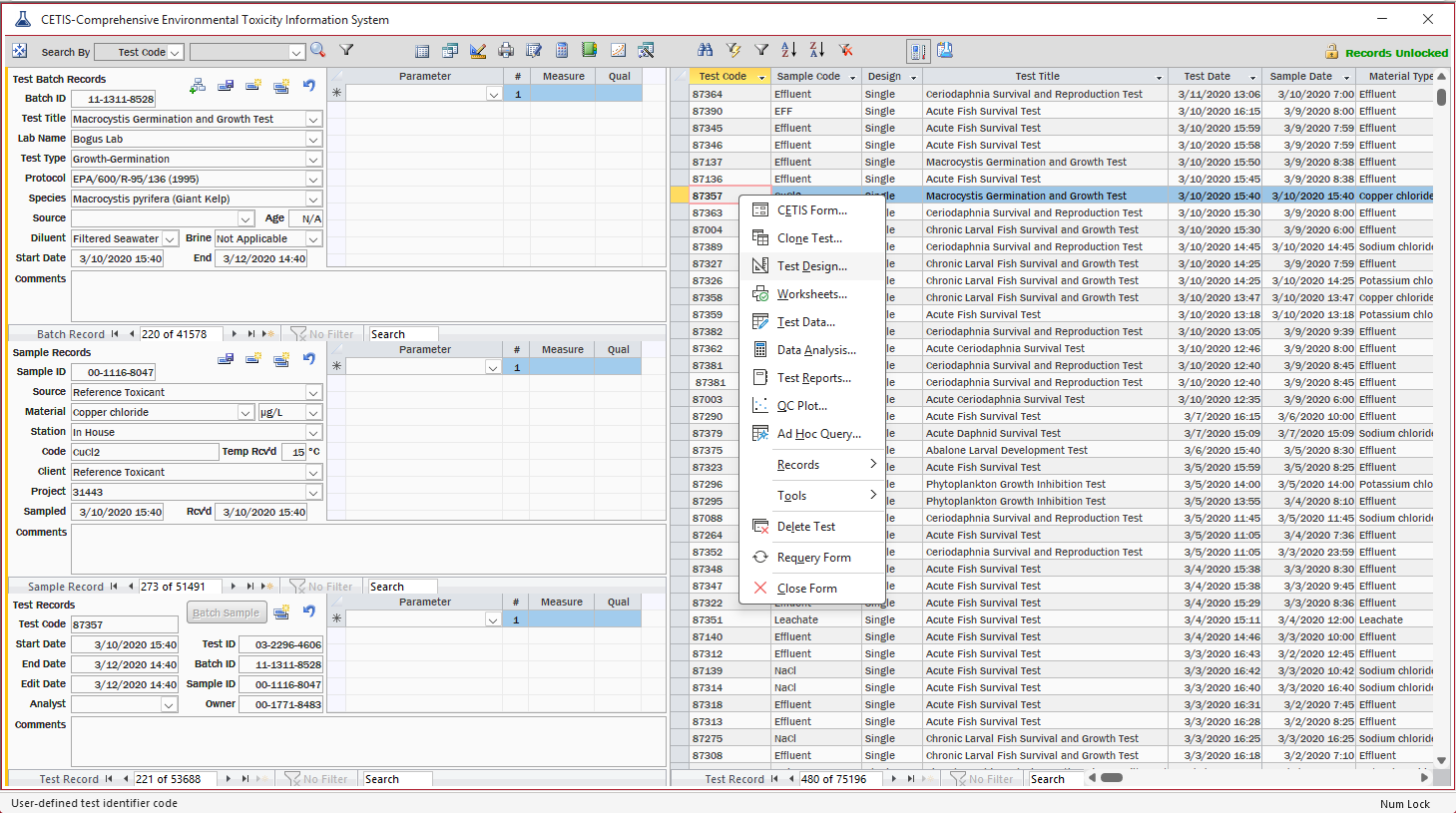
The main CETIS form ties one test batch to its samples and tests in a single linked record, so the whole job is entered once.
CETIS · Test Batch / Sample / Test 01 / 05 · ENLARGE ⤢

The main CETIS form ties one test batch to its samples and tests in a single linked record, so the whole job is entered once.

CETIS · Test Batch / Sample / Test
The main CETIS form ties one test batch to its samples and tests in a single linked record, so the whole job is entered once.
Split file-server design Microsoft Access platform
Front-end · per workstation
CETIS.accde
CETISx64.accde

Interface, forms, reports, and analysis tools. A licensed copy runs on each workstation.

Back-end · shared on server
CETIS.accdb

All data, relationships, and records in one database, shared across every licensed workstation on the network.

connected via linked tables

A test batch applies to one or more samples tested the same day under the same conditions, so a sample's details are entered once and associated to as many tests as needed.

03 Organize

Reports and deliverables, ready to send.

Publication-quality reports, control charts, and electronic data deliverables, customizable down to the endpoint and ready for multi-jurisdictional review.

Reporting
Reports & deliverables

Publication-quality reports, control charts, and electronic data deliverables for individual analyses, summaries, and measurements.

Reporting
WET Evaluation report

Assess a Whole Effluent Toxicity test against established IWC and acceptability criteria, and generate a finding-based cover letter with your agency or company logo.

Acceptability
Test Acceptability Criteria

Apply user-definable criteria to any test type: control response, control CV, PMSD, NOEL, LOEL, or measurements like temperature, pH, or salinity. CETIS flags whether results meet them.

Customization
Fully customizable

From user-definable lists (materials, species, protocols) to entirely new test layouts and endpoints, all shipped with extensive, editable defaults.

Single-sample dilution
Effluents & reference toxicants

Single-sample dilution tests, supported end to end from test setup through reporting.

Multiple-sample designs
Sediment & ambient water

Multiple-sample designs are supported end to end in CETIS, from test setup to reporting.

See it in CETIS
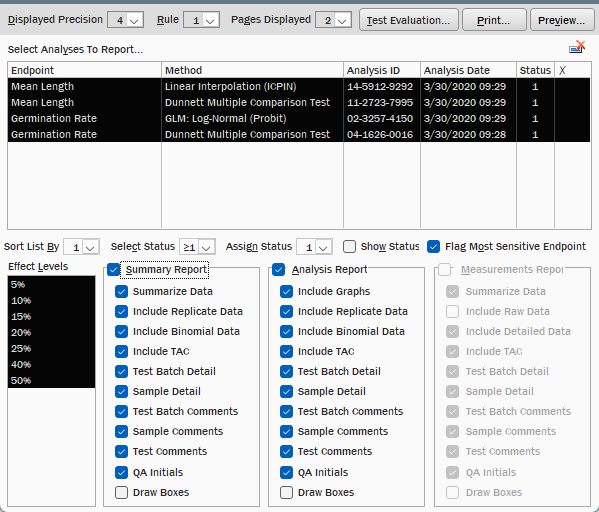
Choose the analyses, endpoints and detail each report carries, then generate it in one pass.
CETIS · Test Reports 01 / 03 · ENLARGE ⤢

Choose the analyses, endpoints and detail each report carries, then generate it in one pass.

CETIS · Test Reports
Choose the analyses, endpoints and detail each report carries, then generate it in one pass.
Voice from the field

Agencies can electronically receive data from CETIS labs, review it for compliance, and issue letters of non-compliance to permittees. The Washington State Department of Ecology runs an electronic WET data-submittal and review system built chiefly on CETIS.

"CETIS has simplified WET data management at every step. I could not do my job nearly as well without it."
Randall Marshall — WET Coordinator, WA Department of Ecology
Before you buy

Common questions.

Post-sale and technical questions live on Support.

You need to know almost nothing about SQL; CETIS does the work behind the scenes. The more you learn about Access, the more you can apply, but very little is required to use CETIS successfully.

Labs have reported that CETIS takes less than one-tenth the time of traditional solutions to input and analyze toxicity data. For a lab processing 500 samples per year at $30/hour, that can represent roughly $15,000 in annual savings.

Yes. You can run CETIS with the free Microsoft Access runtime (2016 or higher). Having at least one full copy of Access is recommended for editing the back-end database if needed.

Yes. CETIS supports single-sample dilution tests (effluents, reference toxicants) and multiple-sample designs (sediment, ambient water), from test setup through reporting.

CETIS has been integrated with the ChemWare Horizon LIMS for a regional client, and Tidepool can provide custom programming to integrate CETIS with your LIMS. Contact us for a quote.

Yes. CETIS ships with a free utility that converts a ToxCalc 5.0 database to the CETIS format, and Tidepool offers a conversion service.

Operating system Windows XP, Vista, or 7, 8, 8.1, 10, or 11
Microsoft Access 32- or 64-bit Access 2016+, Microsoft 365 with Access, or the 2016+ runtime
Memory 8 GB minimum · 16 GB recommended
Disk space 5 GB available
Processor Core i3, i5, i7, or higher
Printer High-resolution laser recommended for reports & graphics

See it against your own data.

We'll walk your team through CETIS on a real dataset and put together a quote for your lab or program.

Request a walkthrough See pricing